

Contenu de l'article
Electric car recharging times: everything you need to know in 2025
The time it takes to recharge an electric car is a concern for many drivers and future owners. Depending on the type of charging station used and the battery capacity, the time required to fully recharge an electric vehicle varies from 30 minutes to several hours. Here’s a detailed guide to charging times and the factors that influence them.
The different types of recharge and their duration
Charging times depend, among other things, on the type of charging station used. Each solution has its advantages and disadvantages in terms of speed, availability and cost.
The classic household socket: a troubleshooting solution
Charging from a standard household socket (2.3 kW) is the most accessible solution, but also the slowest. This option takes over 20 hours to fully charge a medium-sized battery. Smart cables are nonetheless secured to prevent overheating.
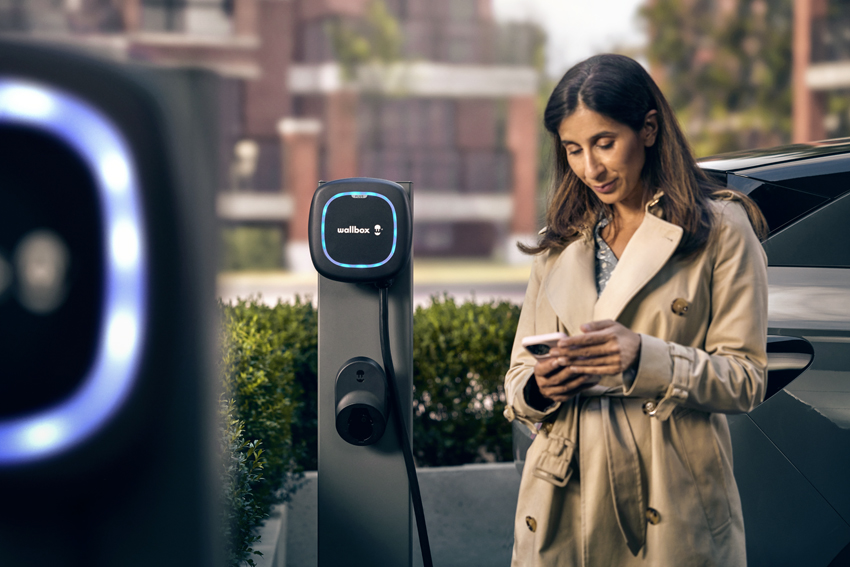
Wallbox: the best compromise for the home
The installation of a home charging station, for example the Wallbox charging station, is the ideal solution for daily charging. With a single-phase output of 7.4 kW, it enables a vehicle to be fully recharged overnight, generally in +/- 10 hours, depending on battery capacity.
The advantages of Wallbox terminal are numerous:
- Optimum safety thanks to integrated safety guards
- Charging speed for everyday use
- Off-peak programming possible
- Precise consumption monitoring
Smappee or Alpitronic: the ideal solutions for your business
In the professional sector, the recommended brands depend on your electrical installation:
- If your electricity comes from alternating current, also known as AC, the brand Smappee brand is highly recommended.
- If your electricity comes from direct current, also known as DC, Alpitronic is recommended with solutions for fast or ultra-fast charging.
How long does it take to recharge an electric car?
AC public charging stations: practical in the city
Charging time for a 22kw charging station
The 22 kW AC charging stations allow you to recharge slower (between 3 and 12 hours on average). They are generally found :
- In public parking lots
- On-street parking spaces
- In shopping centers
- On company parking lots
It’s an ideal solution for recharging during everyday activities: work, shopping, leisure.
DC rapid charging stations: indispensable for long journeys
Fast charging stations, delivering 50 kW or more, are essential for long-distance travel. They can recharge 80% of the battery in 30 minutes. They are mainly found on :
- On freeway service areas
- At service stations
- Near major roads
- On the parking lots

Charging time depending on battery capacity
Battery capacity is an important factor in recharging time. Here’s a detailed analysis by vehicle category. Calculationss are given indicative and must be analyzed according to the electrical installation of your home: If it’s single-phase, your recharge time will be longer than if it’s three-phase.
Electric city cars (40-50 kWh)
Take the Renault Zoé, for example, with its 52 kWh battery. Its charging time is typical of electric city cars:
On a Wallbox from 7.4 kW Wallbox, a full charge takes around 7.5 hours, which is ideal for night-time charging. Using a 22 kW public charging station, the time is reduced to +/- 5h, (time depends on the Zoé’s battery option) ideal for recharging while running errands or at work. On a fast terminal at 50 kW, the Zoé can recover 80% of its capacity in around 1h05.
If the home installation is three-phase, non-public, the terminal will also reach 22kW.
Family sedans (60-80 kWh)
The Tesla Model 3, with its 60 kWh battery, is a good example of this category:
- On Wallbox 11 kW: full recharge in 5h30
- On a 250 kW Supercharger: 80% of the battery in just 20 minutes
Premium SUVs (90+ kWh)
The Audi e-tron, with its 95 kWh battery, is a good example of a top-of-the-range vehicle. Its charging times are proportional to its large capacity:
- On 11 kW Wallbox: fully charged in 8.5 hours
- On 150 kW fast terminal: 80% in 40 minutes
How to optimize your daily refill?
Optimizing charging is essential to preserve the battery and maximize the range of your electric vehicle. Here are the best practices to adopt.
The 20-80% rule: why is it important?
The 20-80% rule is an important principle for recharging electric vehicles. It involves maintaining the battery’s charge level between 20% and 80% of its capacity.
To preserve the battery, avoid extreme charges (0% and 100%) to reduce stress on the cells. The lithium-ion chemistry used in today’s batteries prefers partial charge cycles. By maintaining a charge level between 20% and 80%, you can significantly extend the life of your battery.
Charging speed is also optimal in this range. Recharging slows down considerably above 80% to protect the battery. A charge from 80% to 100% can take as long as a charge from 20% to 80%.
For everyday use, this capacity is more than sufficient.
Other parameters can influence service life, such as the outside temperature or the use of your vehicle’s heating system.
Choosing the right wattage
At home: the importance of proper installation
The installation of a Wallbox of at least 7.4 kW is recommended. It offers :
- Optimum safety with dedicated protection
- Reasonable charging time (overnight)
- Precise control of consumption
- Programmable load ranges
If your installation allows it, a three-phase solution (11 or 22 kW) can be considered. Otherwise, opt for a traditional single-phase installation. A little tip: take a look at your new car, as some models don’t accept single-phase charging, but only three-phase.
On the move: planning and speed
For long journeys, it’s best to draw up a recharging schedule. We recommend :
- Locate fast terminals on your route using specialized applications that provide real-time information on :
- Terminal availability
- Actual power output
- The cost of recharging
- User feedback
- Remember to check your vehicle’s compatibility with the various charging stations. Not all vehicles accept the same charging power. For example, a Renault Zoé accepts a maximum of 50 kW for fast charging, while a Tesla Model 3 can reach 250 kW. A little trick with intelligent charging stations: they adapt to the maximum charging power accepted by the vehicle. There’s no need for a preliminary check, as the terminal can regulate and restrict itself.
- Plan stops every 300 km or so to optimize journey time. A 20-80% charge at a rapid charging station generally takes between 20 and 40 minutes, which is a reasonable break.
What factors influence recharge speed?
The impact of temperature
Temperature plays a role in recharging efficiency. Lithium-ion batteries are particularly sensitive to thermal conditions:
In cold weather (below 0°C) :
- Charge time can be increased by up to 50%.
- The maximum power accepted is reduced
- The battery must first be warmed up
Solution: activate battery preheating before charging, either via the charging planner in the app, or manually about 30 minutes before arriving at the charging station.
In very hot weather (over 35°C):
- Charging is slowed down to protect the battery
- Time can increase by 30%
- The cooling system works harder
Solution: opt for shaded or covered terminals, and avoid the hottest hours of the day.
Battery status
Battery age and use have a direct impact on charging performance:
New battery :
- Accepts maximum power
- Optimum charging times
- Available rated capacity
After 100,000 km :
- Slight reduction in load speed (-10-15%)
- Slightly reduced capacity
- Proportionally longer charging times
After 200,000 km :
- Greater speed reduction speed (-20-25%)
- Reduced capacity
- Significantly longer charging times
Maximum accepted power
Each vehicle model has its own power limits:
Alternating current (AC) :
- Entry-level: 7.4 kW
- Mid-range: 11 kW
- High range: 22 kW
The building’s electrical installation also influences charging capacity.
Direct current (DC) :
- Standard: 50 kW
- Fast: 100-150 kW
- Ultra-fast: 200-350 kW
Practical tips for optimal recharging
Optimizing daily recharging
A good recharging routine optimizes the use of your of an electric vehicle:
- Choose the right wattage for your vehicle
- Allow a margin for future vehicle changes
- Opt for a connected model to monitor consumption
- Off-peak programming :
- Reduce the cost of recharging
- Avoid consumption peaks
- Maintenance between 20% and 80% :
- Extending battery life
- Optimizing load performance
- Maintaining a reserve of autonomy
Preparing for long journeys
Planning is essential for long-distance travel:
Terminal markings :
- Identify fast terminals on the route
- Check alternatives in case of unavailability
- View feedback
Reloading strategy :
- Prefer several partial loads
- Maintain a level between 20% and 80%.
- Plan activities during the load
Use of dedicated applications :
- Route planning
- Terminal status in real time
- Rates and payment methods
How do I calculate recharge time?
The basic formula
Theoretical recharge time is calculated using a simple formula:
Charging time (hours) = Battery capacity (kWh) ÷ Terminal power (kW)
For example, for an electric car with a 60 kWh battery on an 11 kW Wallbox: 60 kWh ÷ 11 kW = 5.45 hours, i.e. about 5.5 hours.
However, this formula gives a theoretical estimate that does not take several factors into account:
- The non-linear load curve
- Conversion losses
- Battery temperature
- On-board charger efficiency
Here is an example of recharging time for a vehicle with an 80 kWh battery and a recharging capacity of 11 kW AC and 100 kW DC:

Concrete examples by vehicle type
Electric city cars (40 kWh)
Let’s take the example of a Peugeot e-208 with a 50 kWh battery:
- On Wallbox 7.4 kW: 7h30 from 0 to 100%.
- On 50 kW fast terminal: 45 minutes from 20% to 80%.
- On a 100 kW high-speed terminal: 25 minutes from 20% to 80%.
Real time is slightly higher than theoretical calculations due to losses and thermal management.
Family sedans (75 kWh)
For a long-range model :
- On Wallbox 11 kW: 7h from 0 to 100%.
- On Supercharger V3 (250 kW): 20 minutes from 10% to 80%.
- On standard fast terminal (50 kW): 1h30 from 10% to 80%.
FAQ : Frequently asked questions about recharging
Does rapid charging damage the battery?
Fast charging does not directly damage the battery if used in moderation. However, intensive use can accelerate ageing. Recommendations:
- Limit to 1-2 fast loads per week
- Prefer loading between 20% and 80%.
- Prioritize the slow charge for daily use
Can I stay in the vehicle while it’s being charged?
It is perfectly possible to remain in the vehicle during charging, but a few precautions must be taken:
- Pacemaker wearers should avoid the immediate vicinity of the charging point.
- Air conditioning and heating can be operated
- Multimedia system remains usable
- The vehicle cannot be started while charging
How much range can you recover in an hour?
The range recovered depends on the charging power:
From domestic socket (2.3 kW) :
- 15-20 km range per hour
- Suitable only for back-up
On Wallbox 7.4 kW :
- 50-60 km range per hour
- Ideal for daily recharging
On 50 kW fast terminal :
- 200-250 km range per hour
- Perfect for breaks on long journeys
On supercharger (150+ kW) :
- 400-500 km range per hour
- Optimal for minimizing downtime
What is the average life of a battery?
Modern batteries have a long service life:
- Mileage: 160,000 to 320,000 km
- Life: 15-20 years in normal use
- Manufacturer’s warranty: generally 8 years or 160,000 km
- Average degradation: 2-3% per year
Life-extending factors :
- Within the 20-80% range
- Slow load preferred
- Avoidance of extreme temperatures
- Smooth ride
How do you manage recharging in a condominium?
Installation in condominiums requires a specific approach:
- Group solutions available
- Automatic rebilling systems
Installation requires :
- Co-ownership agreement
- Preliminary technical study
- Standard-compliant installation
- Individual metering system
How much electricity does a car consume at rest?
A car’s power consumption at rest depends mainly on the systems that remain active, such as the alarm, on-board electronics, use of an air-conditioning system and so on. Other factors may also be taken into consideration, such as battery temperature in winter, software updates or network connection.
Conclusion
Charging an electric vehicle requires some adaptation of habits, but quickly becomes natural once you understand the important factors. Charging times, although longer than a full tank of petrol, are easily integrated into everyday life thanks to home charging. For longer journeys, planning and using fast charging stations means you can travel with peace of mind.
Key points to remember :
- Choose a terminal Wallbox for daily recharging at home
- Choose a terminal Smappee for charging charging
- Respect the 20-80% rule
- Planning long journeys
- Use fast charging sparingly