This page was written by
Simon Bihain
Co-founder of Vectura




Do you work with a commercial vehicle? Install a charging station now to save time and money. Make an appointment with one of our experts and get all the answers to your questions. It's the perfect time to take action!
Electric commercial vehicles have larger batteries (often 70 kWh or more). They therefore require more powerful charging stations. For professional use, we recommend installing either a 22 kW three-phase charging station, or a 50 to 150 kW fast charging station. The higher the wattage, the faster your vehicles are available. An indispensable asset if you use your vans on a daily basis.

The type 2 connector is the European standard for AC charging. It is widely used for commercial vehicles, enabling both single-phase (up to 7.4 kW) and three-phase (up to 22 kW) charging.


The CCS connector is used for fast DC charging. It is capable of delivering up to 150 kW, making it ideal for commercial vehicles requiring rapid recharging between missions.

Less common for commercial vehicles in Europe, this type of connector is used by certain models of Japanese electric vehicles for rapid DC recharging.
We continually strive to satisfy our customers. We offer tailor-made solutions for your sector of activity.
Charging stations
Charging stations
Charging stations
Charging stations
Charging stations
Charging stations
Charging stations
Charging stations
Install a charging stations for your electric commercial vehiclesoffers many tangible benefits for your company:

Wall-mounted charging stations are a compact, easy-to-install solution, ideal for businesses with limited space or for garages. They offer average charging power of up to 22 kW three-phase, and are ideal for small commercial vehicles. Their cost is generally lower than that of floor-mounted charging stations.
Free-standing charging stations are often chosen for parking lots or outdoor areas, which are then equipped with several charging points, making them ideal for fleets of commercial vehicles. Some are also suitable for fast charging and can deliver over 50 kW, ideal for large vans and other commercial vehicles.
Fast direct current (DC) charging stations are needed for commercial vehicles that require rapid recharging between trips. These charging stations can deliver between 50 and 150 kW, enabling a commercial vehicle to be recharged in less than an hour. They are more costly to install, but indispensable if your vehicles do a lot of driving and need to be ready quickly between two journeys.
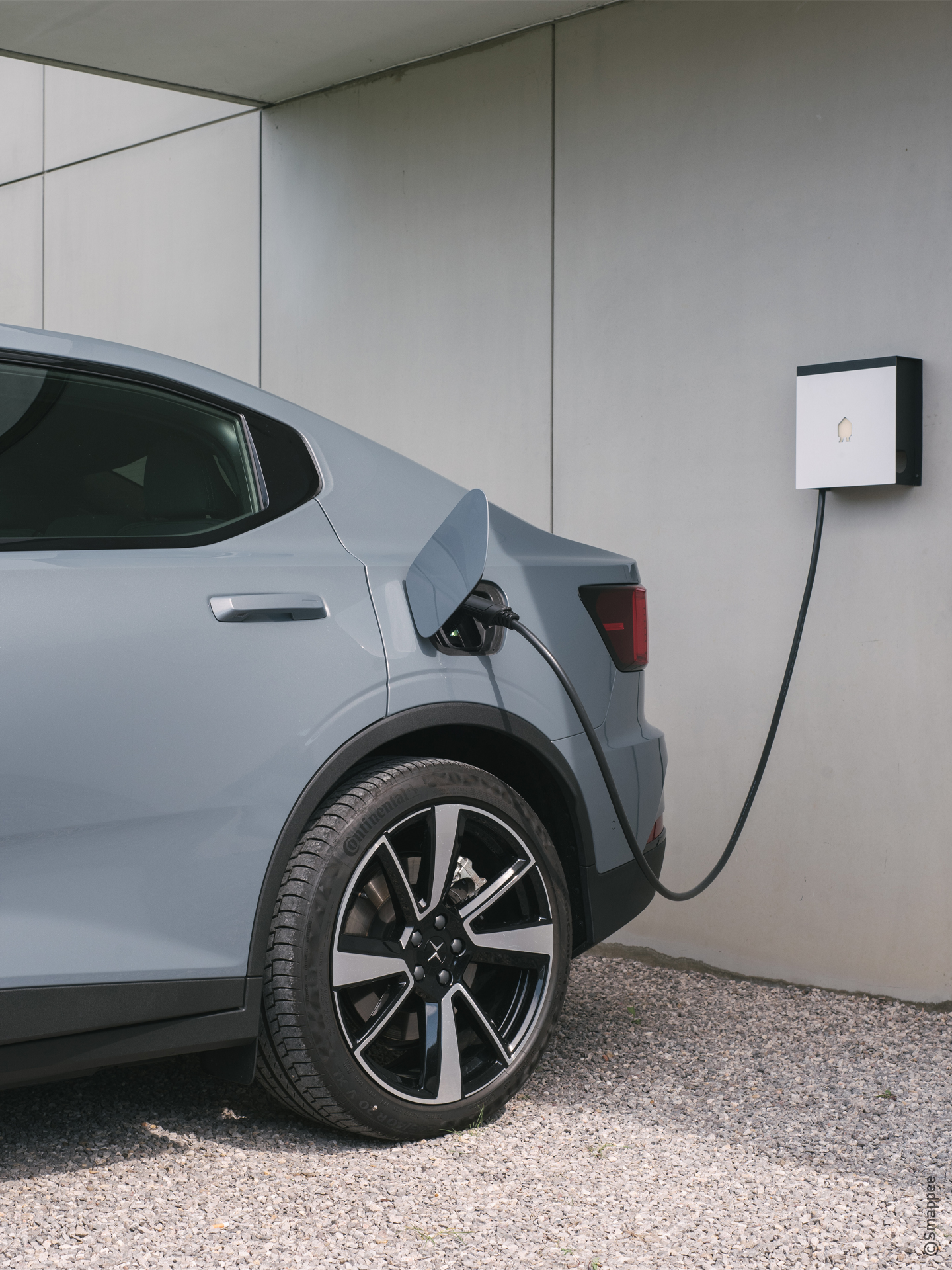
The cost of installing a charging stations for commercial vehicles depends on a number of factors:
A 22 kW wall-mounted charging station does not cost the same as a 150 kW rapid charging station. The higher the wattage, the more technology and equipment are required.
The distance to the electrical panel, the need for connection work and the layout of the parking lot also influence the budget.
A company with a single commercial vehicle has different needs to a fleet of ten vans. The price also depends on integrated services: diagnostics, installation, commissioning, maintenance and follow-up.
As each installation is different, it is essential to carry out a study with one of our experts to define the solution best suited to your needs and budget.
Request a free a free estimate and receive a clear, customized proposal.

Discover below all the electric vehicle brands compatible with our charging stations. Our stations are compatible with all electric vehicles currently available on the market.





































An expert performs a detailed site analysis to determine potential obstacles, such as power supply availability and location restrictions.

Once the needs and restrictions of the site have been assessed, the expert presents different options for charging stations, depending on the quantity required, power and location.

Once all the formalities have been completed, the charging stations can be installed. The certified installer will ensure that the installation runs smoothly, in compliance with safety standards.
It all depends on three things:
In practice :
Tip: aim for 80% charge is often sufficient, as the last 20% takes longer to fill to protect the battery.

There are several well-known manufacturers of charging stations for commercial vehicles, including Wallbox, Alfen, Smappee, Schneider Electric, EVBox and ABB. Each brand offers solutions tailored to business needs, with intelligent features such as charging management and connectivity.

We are experts in installing charging stations, photovoltaic panels and storage batteries. Thanks to our recognised expertise, we offer customised, reliable solutions that comply with the most stringent standards. By choosing us, you are opting for a sustainable, economical energy transition supported by a team committed to your satisfaction.
Our supercharger charging station placement team lists the most recurrent themes on fast chargers.
The service life of a charging station depends on the quality of the materials used, the conditions of use and the frequency of maintenance. In general, it is estimated that a well-maintained charging station can last more than 10 years.
The ideal location should be easily accessible, close to an adequate power supply and protected from the elements. It is also important to take into account the length of the charging cable and any environmental constraints. Locations with high traffic density are often desirable (close to motorways, in commercial parking lots, etc.).
For private individuals, there is no specific financial aid for superchargers. For professionals, the investment can be amortized like any other accounting investment.
The main difference lies in charging power. A fast charging station delivers more power, enabling an electric vehicle to be recharged in a few minutes or tens of minutes, whereas a slow charging station requires several hours.
Maintenance of a fast-charging station includes regular checks on operation, cleaning of connectors and visual inspections. This type of charging station does not require complex maintenance.
A number of elements need to be analyzed at the start of the project: the study of the electrical installation, the study of a possible network adaptation, the connection request, the provision of power from the network operator, the earthworks, any town planning authorizations, etc. Our team takes care of all these steps.
Yes, that’s right. Charging stations are universal. A charging station installed for your commercial vehicle can therefore also charge a conventional electric car, without any difficulty.
The only difference is the power the vehicle can accept: a car limited to 50 kW won’t be able to take full advantage of a 150 kW charging station, but it will still be able to recharge safely.
This makes the commercial vehicle charging station a versatile investment that meets the needs of your entire fleet, whether vans or cars.
Not necessarily. For commercial vehicles, a 3x400V three-phase connection is recommended, as it enables faster, more efficient recharging. However, if your site doesn’t have one, there’s no need to worry: there are charging stations compatible with other types of connection (3x230V or 2x230V).
In practice, this means that almost any company can install a terminal without having to carry out major work. When assessing your site, our experts will guide you towards the most suitable and cost-effective solution.
A correctly installed and well-maintained charging station can operate trouble-free for more than ten years. Its longevity depends on a number of criteria, such as the quality of the equipment chosen, the power used on a daily basis and compliance with safety instructions. So it’s not just a question of technical equipment, but a long-term investment.
By choosing a high-performance bollard and a qualified installer, you’re equipping your business with a solution that will reduce your energy costs and keep you moving for many years to come.
In ultra-fast charging station installations, the cables are directly connected to each charging station. As a result, your household cable will not be used for ultra-fast charging.

Simon Bihain
Co-founder of Vectura