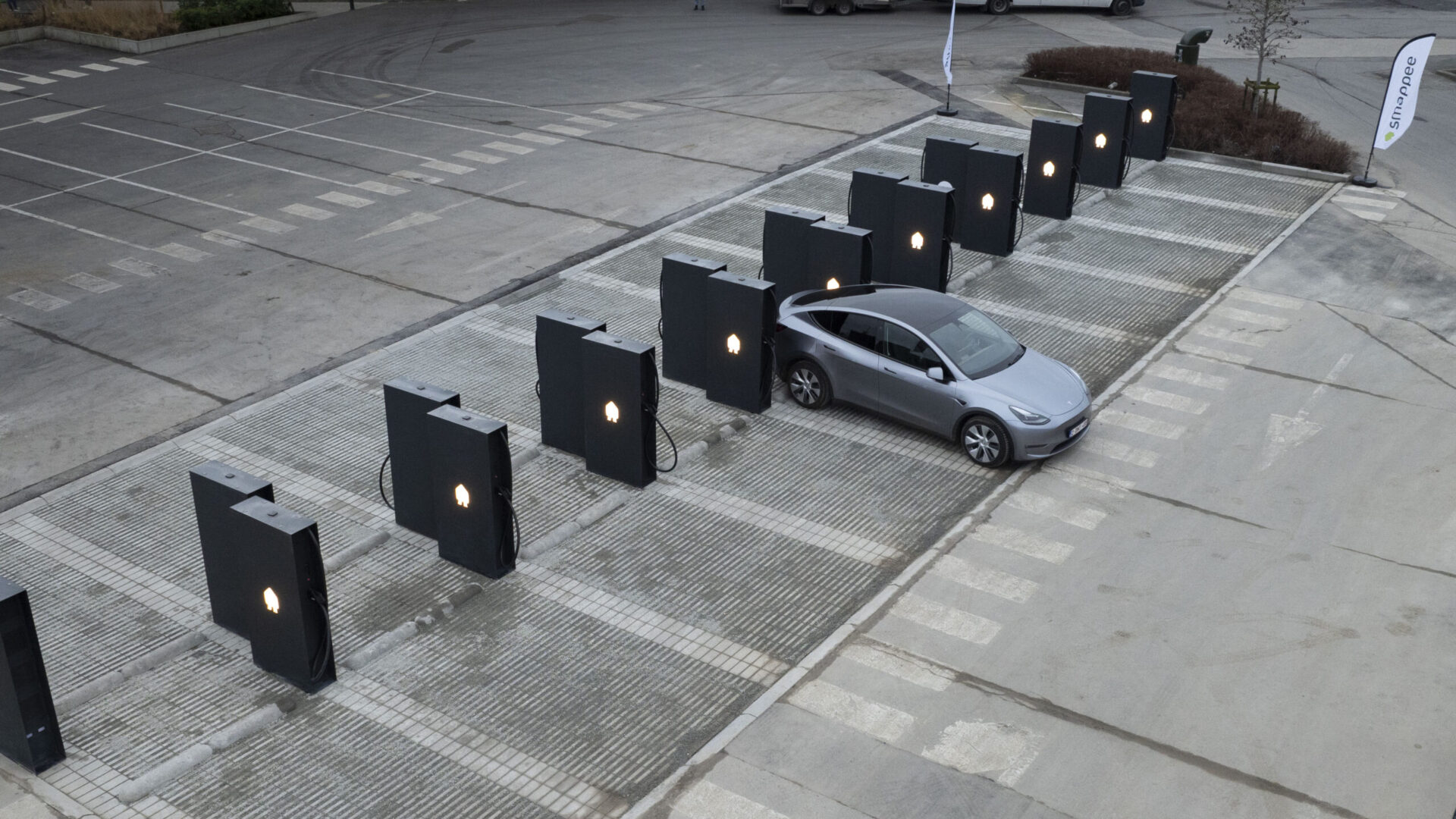


Electric vehicles are on the increase. To meet this demand, charging stations in parking lots are becoming a common are becoming commonplace, and sometimes even compulsory. You already see them in supermarkets, businesses and public parking lots, and the trend is set to grow.
We help you to anticipate by explaining what the law says and how you can adapt your parking lot before it’s too late.
Contenu de l'article
Where can I find a charging station?
More and more parking lots are equipped with charging stations.. Some are accessible to all, others are reserved for internal use. Here are the most common cases.
Public parking lots
These are generally managed by the commune or town. You’ll often find charging stations in parking lots, town centers, shops and in town centers, shops and transport facilities. Access is free, with payment by the minute or kilowatt-hour.
Parking lots for public institutions and companies
In company, hospital, hotel or airport parking lots, charging stations are used by staff or visitors are used by staff and visitors alike. They are increasingly in demand… and sometimes even mandatory.
Commercial parking lots
In supermarket, store or gallery parking lots, …. You can leave your car there while you do your shopping and leave with a fully loaded car.
Residential parking lots
Apartment buildings are gradually integrating charging stations in their parking lots.. These may be private charging points, or shared with other owners.
Legal requirements and standards to be met by 2025
In Belgium, regulations governing the installation of charging stations in parking lots vary according to region (Wallonia, Flanders, Brussels) and according to the type of building (new, renovated, private or public).
Failure to comply may result in fines. Better to anticipate than to have to pay later. Here’s what you need to know to be in compliance in 2025.
In Wallonia
In Wallonia, PEB regulations specify the requirements for the installation of charging stations for electric vehicles.
- From 10 parking spaceswiring must be provided for at least 20% of parking spaces.
- Since January 1, 2025, non-residential buildings with more than 20 parking spaces must be equipped with a charging station for at least one out of every five spaces.
- Some communes offer assistancebut this depends on local budgets. To find out more, contact your local authority.
In Flanders
Flanders also imposes parking regulations for public buildings, shops and new buildings with more than 10 spaces.
- Visit pre-wiring is mandatory for 20% of pitches.
- You must install at least 1 terminal in any parking lot accessible to the public.
- Refill prices must be displayed.
- Companies can deduct part of the costs in their taxes.
In Brussels
Brussels is adopting a gradual approach, with an ambitious plan for the development of terminals.
- From 10 parking spacesactive bollards must be installed for at least 10 % of office spaces, and 5 % for other buildings.
- If public funds are used, the terminals must be accessible to all.
- A guide is available to help condominiums make the right choice and comply with regulations. To find out more, contact your local council.
What types of charging stations are available in public parking lots?
In public parking lots, charging stations can be different. may be different. There are different models depending on power, current type and technology. Here’s what you’ll find in Belgium today.
AC or DC terminal: what’s the difference?
- AC (alternating current) This is the most common type of charging. Suitable for normal charging (3 to 22 kW). Ideal for 1 to 3-hour stops.
- DC (direct current) used for fast charging. DC terminals range from 50 to 350 kW. You can regain up to 80% of your battery in 20 to 40 minutes.
| Terminal type | Power (kW) | Recharging time (approx.) | Recommended use |
|---|---|---|---|
| AC standard (7.4 kW) | 7,4 | 4 to 6 hours | Company parking lot, hotel |
| Heavy-duty AC (22 kW) | 22 | 1 to 2 hours | Shopping centers |
| DC fast (50 to 150 kW) | 50 à 150 | 30 to 60 minutes | Highway areas, roads |
| DC high-speed (up to 350) | 150 à 350 | 15 to 30 minutes | Long distances, road junctions |
The majority of charging stations in parking lots offer at least one offer at least one type 2 socket and one CCS socket. This is the minimum to guarantee compatibility with all recent electric vehicles.
Prices, duration, means of payment for charging stations in parking lots
Would you like to know how much it costs charging station in a parking lot? ? Here’s the latest information (July 2025) to give you an idea.
Recharge time
It all depends on the terminal used and your vehicle. On average :
- A 22 kW AC terminal requires 3 to 6 hours.
- On a DC 50 kW terminal, 30 to 60 minutes is sufficient.
- With a fast terminal, it takes just 20 minutes to recover 80%.
Pricing
This will depend on the operator… Here are the three most common models:
| Billing method | Average price |
|---|---|
| Per kWh consumed | 0.35 to 0.70 € / kWh |
| Time-based (per minute) | 0.10 to 0.50 € / min |
| Package + session fee | 1 € per session + kWh/minutes |
Accepted means of payment
Today, several solutions are available:
- Refill card
- Mobile application
- Payment by QR code
- Bank card terminal (more common in Flanders)
Case study – Car park for an exhibition in Brussels
A temporary exhibition in Brussels welcomed hundreds of visitors and around fifty employees every day. In order to be able to recharge electric vehicles and comply with regional standards, the organizers called on Vectura to equip the site’s parking lot.
The solution implemented by our team
Following a technical visit and needs assessment, our team installed four 22 kW AC charging stations, accessible to both staff and visitors. The aim was to provide an electric recharging solution.
So what are you waiting for to request information about equipping your event or site?
What you need to know about charging stations in parking lots
Are you planning to install charging stations in your parking lot? Great idea! You’ll not only be meeting the expectations of electric vehicle owners, but also complying with current legal requirements.
To guide you every step of the way, our team is with you from the first exchange to the final tests after installation.
Have a question? Get in touch with us and and schedule an appointment with one of our experts.